
Estimated reading time: 8 minutes
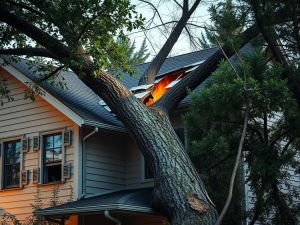
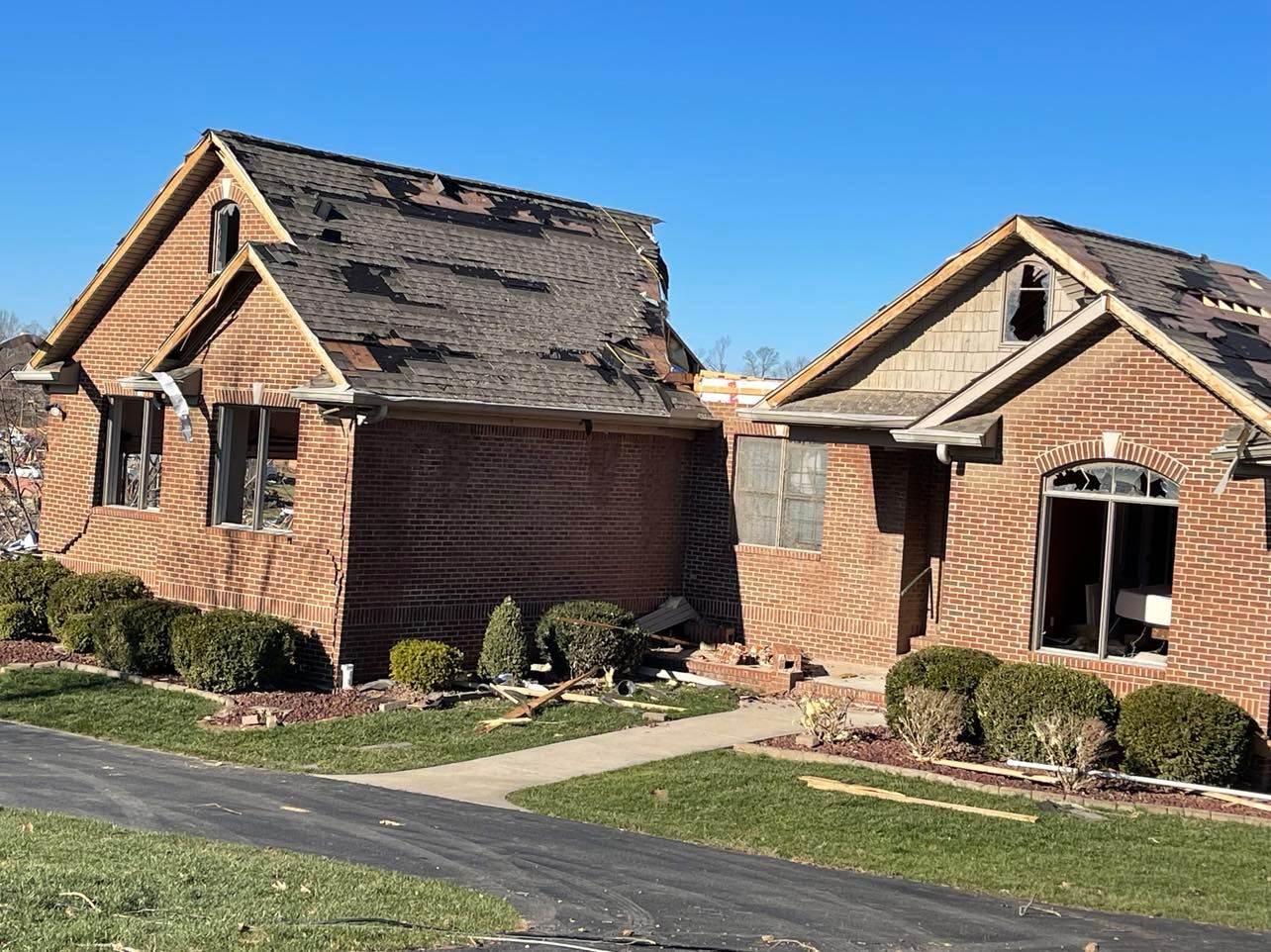
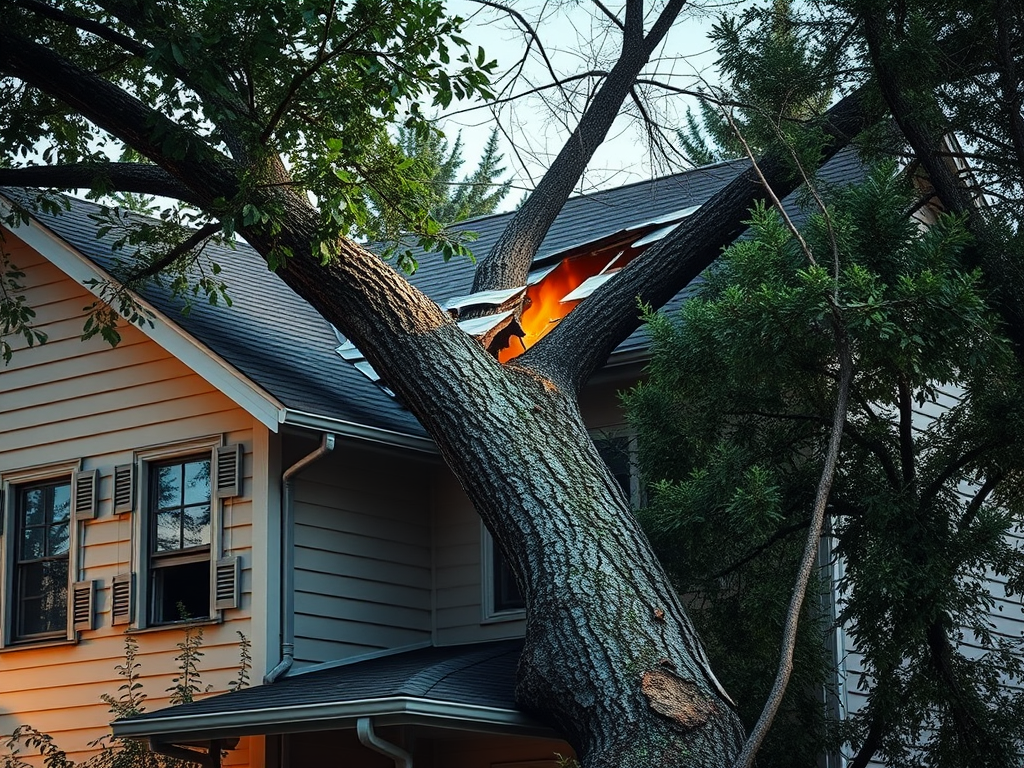
When a tree strikes a home or commercial building, the damage goes far beyond what is visible from the exterior. What may initially appear to be limited to roof damage or exterior puncture often involves deeper, more complex structural damage from tree impact that affects the integrity of the entire building system.
A fallen tree introduces sudden, concentrated load forces that most structures are not designed to withstand in a single point of impact. Unlike wind uplift or hail damage, tree strikes create direct compression and lateral force, which can:
- Shift or fracture roof trusses and rafters
- Compromise load-bearing walls and framing connections
- Cause ridge beam displacement and uneven weight distribution
- Transfer force down through the structure into ceilings, floors, and even the foundation system
These impacts often result in hidden structural damage that is not immediately visible during a standard inspection. For example, a roof may be temporarily tarped and appear stable, while underlying framing members are cracked, twisted, or overstressed—leading to progressive structural failure over time. Reference this case study conducted by Haag Engineering for a historic home to learn more.
In commercial properties, the risks are even more complex. Tree impact can disrupt:
- Steel framing systems and connection points
- Roof decking and membrane assemblies
- Mechanical systems mounted on the roof (RTUs, HVAC units)
- Electrical and fire suppression systems running through structural cavities
This type of loss frequently requires engineering evaluation, structural reinforcement, and code-compliant reconstruction, all of which must be properly identified and documented early in the claims process.
The key issue—and the reason this is often referred to as a hidden risk—is that insurance assessments may initially focus on visible damage, while overlooking the full structural scope of loss. Without proper documentation and advocacy, critical components of the building’s structural system may be under-scoped or excluded entirely from the claim.
Understanding the true extent of structural damage from tree impact is essential to ensuring that repairs are not just cosmetic—but that the property is restored to a safe, stable, and code-compliant condition.
1. Load-Bearing System Disruption
A tree impact can compromise:
- Roof trusses and rafters
- Load-bearing walls
- Ridge beams and structural connectors
Even if the roof appears “partially intact,” the load path of the structure may be compromised, creating long-term instability.
The load path is how weight travels through a building (roof → walls → foundation). If it’s compromised, that path is disrupted—meaning structural loads aren’t properly supported, increasing the risk of sagging, shifting, or collapse.
2. Progressive Structural Failure
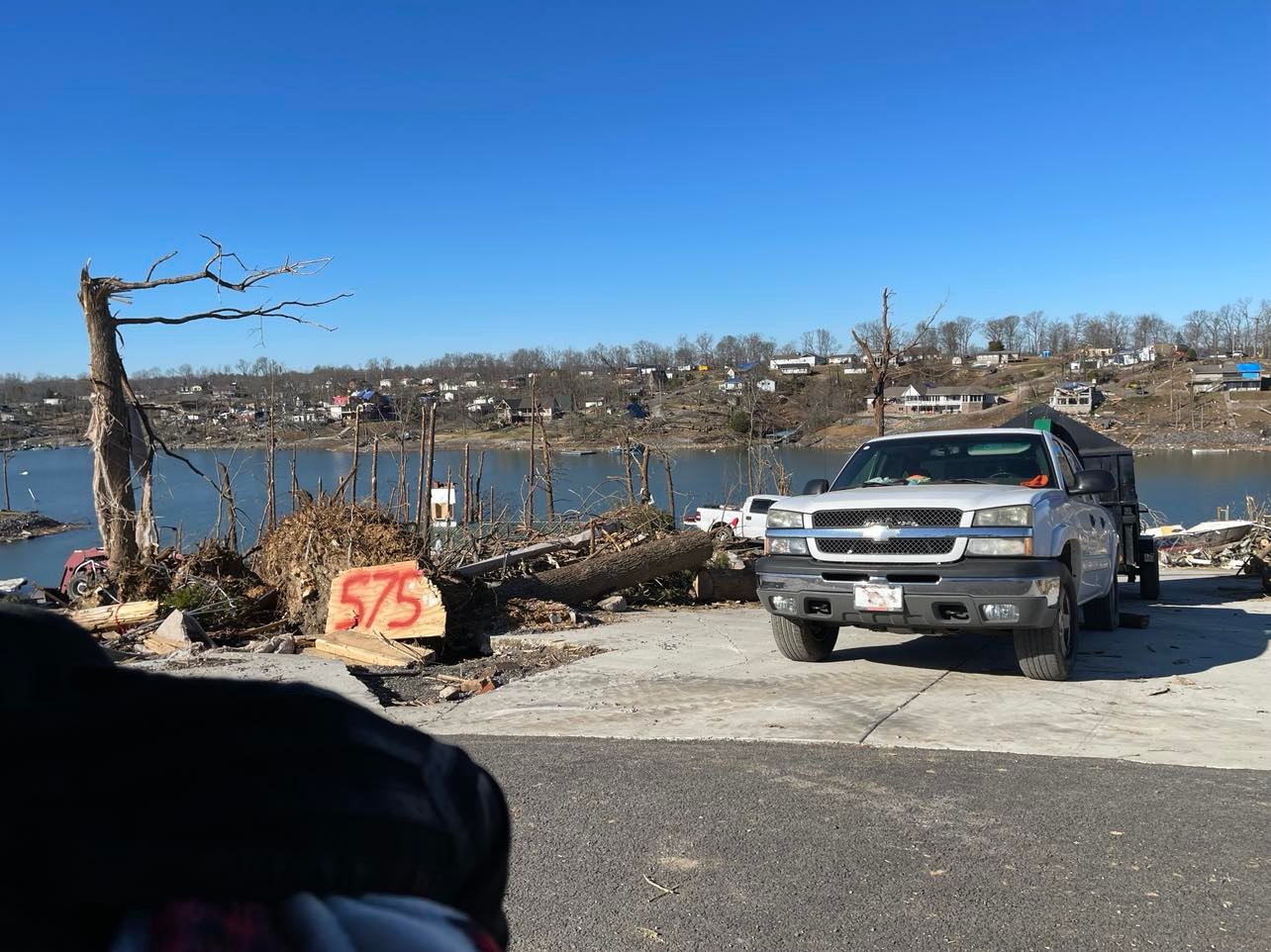
Storm reports across the Midwest documented:
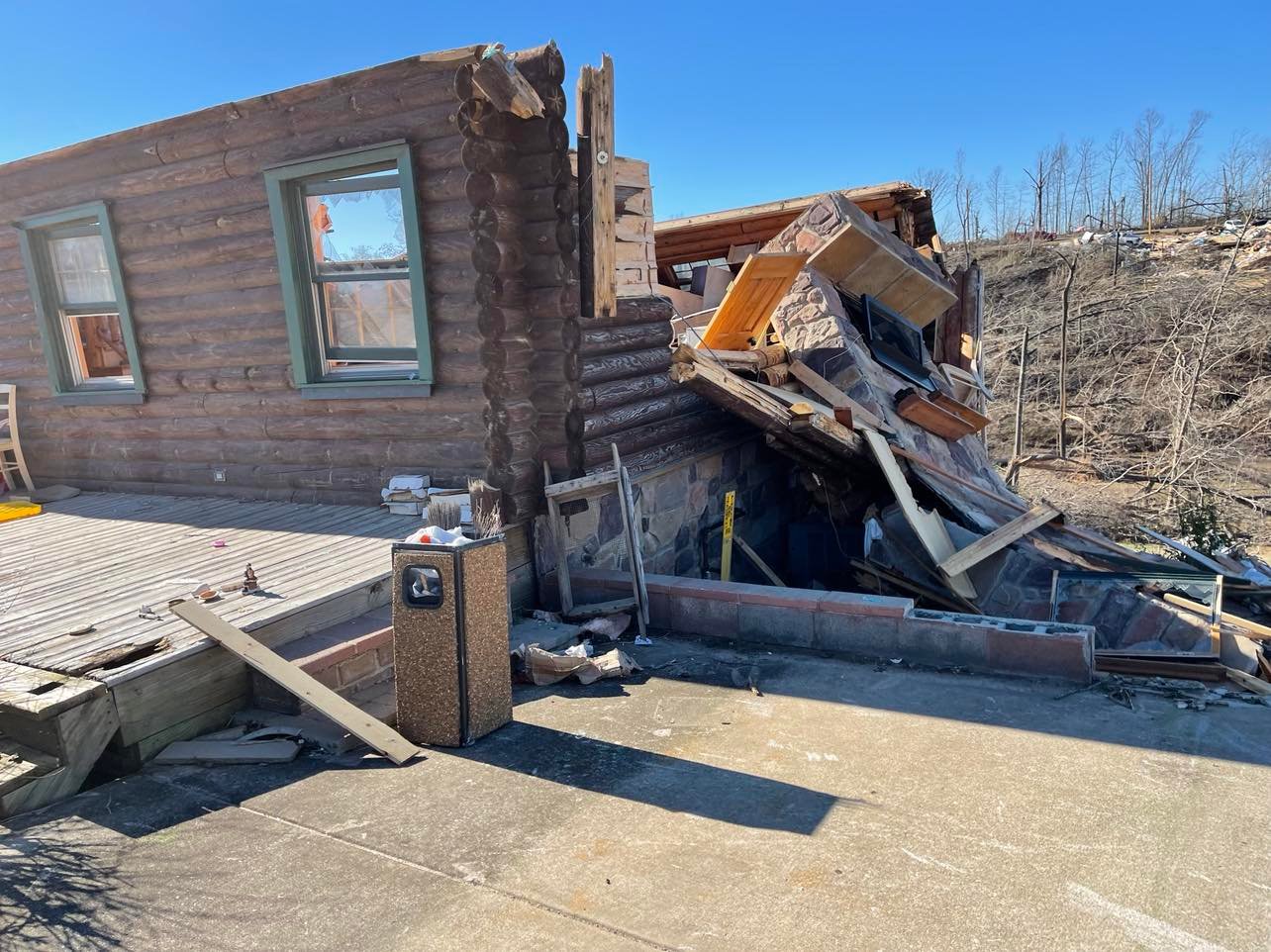
- Roof sections torn off buildings
- Exterior walls collapsing after initial impact
- Interior framing shifting due to weight transfer
Wind gusts exceeded 70–85 mph, strong enough to topple mature trees and damage structures.
Tree weight combined with wind pressure can cause delayed structural failure, especially if emergency mitigation is not properly executed.
3. Commercial Property Risks
For commercial buildings, tree impacts often affect:
- Flat roof membrane systems
- Steel framing connections
- Mechanical systems (RTUs, ductwork, electrical runs)
A single tree strike can shut down operations (business interruption), trigger required repairs to meet current building codes (code upgrades), and necessitate expert evaluation of structural damage (engineering requirements). Each of these carries additional costs that must be clearly documented and supported to ensure full insurance recovery under the policy.
According to the Center for National Association of Insurance Commissioners (NAIC), commercial property coverage pays for actual physical damages or losses, while business interruption (BI) covers lost net income due to the closure of the business while repairs are underway. These policies may cover rent or lease payments, relocation costs, employee wages, taxes, and loan payments.
Why Early Involvement of a Public Adjuster Matters
In tree-impact losses, timing is critical. The decisions made in the first 24–72 hours can significantly affect the outcome of the claim. Licensed public insurance adjusters can manage and coordinate the communication between the insurance company and the policyholder in many states. Why is this important?
1. Structural Documentation Before Alteration
Emergency crews often:
- Remove trees
- Tarp roofs
- Begin demolition
While necessary, these actions can destroy key evidence of structural damage. Not the confirmation that damage occurred, but the investigatory clues as to what the root cause of the material or building failures were. This is crucial information for the insurance company. Especially if an adjuster is not immediately dispatched in the wake of overwhelming storm surge/volume.
Among other things, a licensed public insurance adjuster ensures:
- Pre-mitigation photo and video documentation
- Identification of structural vs. cosmetic damage
- Coordination with engineers when needed
2. Scope Development vs. Surface-Level Estimating
Insurance carriers may initially scope:
- Shingle replacement
- Minor repairs
However, tree impacts frequently require:
- Full roof system replacement
- Structural reinforcement or rebuild
- Code-compliant upgrades
Without early advocacy, structural components may be overlooked or undervalued. Meaning, critical elements like framing, trusses, and load-bearing walls are sometimes missed or under-scoped during initial inspections, leading to repair estimates that don’t fully account for the true extent or cost of structural damage.
It can be difficult to bring in experts (such as an architect or an engineer), or a public adjusters six (6) months after the damage occurred to favorably evaluate the cause of the now-disputed damage.
3. Policy Interpretation & Coverage Maximization
Tree losses often involve multiple coverages:
- Dwelling/Building (Coverage A)
- Other Structures (typically Coverage B)
- Debris Removal (Coverage C)
- Ordinance & Law (required building code updates)
- Business Interruption (financial reimbursement of lost revenue for commercially insured policyholders)
A public insurance adjuster helps ensure all applicable coverages are triggered and properly applied.
A public insurance adjuster reviews the policy and the loss in detail to identify every coverage that may apply—such as dwelling/building, contents, debris removal, ordinance and law, and business interruption. They connect documented damages to specific policy provisions, ensure nothing is missed, and present the claim in a way that supports full and proper application of benefits owed under the policy.
Contents Damage: The Most Overlooked Opportunity
When a tree breaches the structure, it often introduces water intrusion, insulation and debris contamination and structural collapse debris onto personal property. One of the biggest mistakes policyholders make after a tree impact loss is failing to thoroughly document personal property or business personal property contents before pack-out.
This leads to mixed damage conditions that are difficult to reconstruct later.
Best Practice: Document Before Movement
Before any pack-out or removal occurs:
- Room-by-room photo documentation
- Line-by-line inventory creation
- Condition classification (cleanable vs. non-salvageable)
- Identification of high-value items early
Once contents are removed without documentation:
- Items lose positional context
- Damage causation becomes harder to prove
- Recovery is often delayed or reduced
Early Documentation = Faster Recovery
Proper documentation allows:
- Immediate initiation of contents claims (Coverage C or Business Personal Property)
- Faster advance payments from carriers
- Reduced disputes over valuation
For underinsured policyholders, this step is especially critical to maximize available recovery within policy limits. Because policy limits cap recovery, early, detailed documentation ensures every covered item is properly claimed—maximizing payout within those limits.
If losses exceed coverage, some policyholders may recover a portion of the uninsured loss through casualty loss deductions on their federal tax return (subject to IRS rules, thresholds, and documentation requirements). Consulting a CPA or tax professional is recommended to determine eligibility and proper filing.
See what the Internal Revenue Service (IRS) recommends when faced with casualty loss deductions.
The Intersection of Structural & Contents Claims
Tree damage claims are rarely isolated to one category. Instead, they create a combined loss scenario:
- Structural damage (roof, framing, load path)
- Interior damage (ceilings, drywall, flooring)
- Contents damage (furniture, inventory, equipment)
- Environmental contamination (water, debris, possible mold)
Without coordinated documentation, these categories can become fragmented across multiple vendors and repair estimates or scopes, leading to gaps in recovery.
Key Takeaways for Property Owners
If your property was affected by the March 2026 Midwest storms:
- Do not rush into demolition or pack-out without documentation
- Assume structural damage even if it is not immediately visible
- Engage professional advocacy early in the process
- Document contents before anything is moved or discarded
- Ensure all applicable coverages are explored—not just the obvious ones
Final Thought
Storm-related tree damage is one of the most complex property losses because it combines force, weight, and structural compromise in a single event. While the damage may appear straightforward at first glance, the underlying impacts can be significant—and costly if not properly documented and presented.
Early, strategic involvement from experienced professionals can mean the difference between a partial repair and a fully funded recovery.
Disclaimer
This content is for informational purposes only and does not constitute legal, engineering, or insurance coverage advice. Every claim and policy is unique, and outcomes depend on specific facts and policy terms.
Green Public Insurance Adjusting is a licensed public adjusting firm and does not provide legal or construction services. Nothing in this article guarantees claim results or coverage determinations. Property owners should consult with appropriately licensed professionals before making decisions regarding repairs or insurance claims.
Related Links/Recommended Read:
- When a Pipe Bursts in Extreme Cold: What to Do Next — and How to Protect Your Insurance Claim
- When a Claim Fails Before It Begins: What Leonard v. State Farm Teaches About the Value of a Public Adjuster
- When Settlement Funds Fall Through the Cracks: Protecting Clients and Your Business
- Preparing Your Claim After You Suffer Damages
- Winter Fire Prevention: Common Causes and How to Protect Your Property